Dry vs. Steam Sauna: What’s the Difference? + Complete Spa Guide
The Ultimate Guide to Dry vs. Steam Saunas: Choosing Your Path to Deep Relaxation
When it comes to unwinding, detoxifying, and melting away daily stress within a luxurious spa environment, understanding the difference between a dry and a steam sauna is the essential first step toward tailoring your wellness journey. In short, the fundamental distinction lies in their heat and humidity levels: a dry sauna operates with intense, dry heat generated by a stove or heated rocks, whereas a steam sauna creates a fully humid environment featuring dense water vapor and a milder ambient temperature. Making an informed choice between these two thermal systems profoundly impacts skin pore dilation, muscle recovery, and nervous system relaxation.
At Niloufar Abi Spa and Massage Center, the seamless integration of these thermal therapies with modern and traditional relaxation techniques creates an immersive voyage toward total body and mind rejuvenation. In this comprehensive guide, we will explore the distinct characteristics, specific health benefits, and vital safety tips you need to know before stepping into a thermal cabin, ensuring you make the best choice for your personal self-care routine.
Structural and Environmental Differences: Dry Sauna vs. Steam Sauna
To fully appreciate the differences between a dry sauna and a steam sauna, we must examine their physical construction, heat generation methods, and moisture levels.
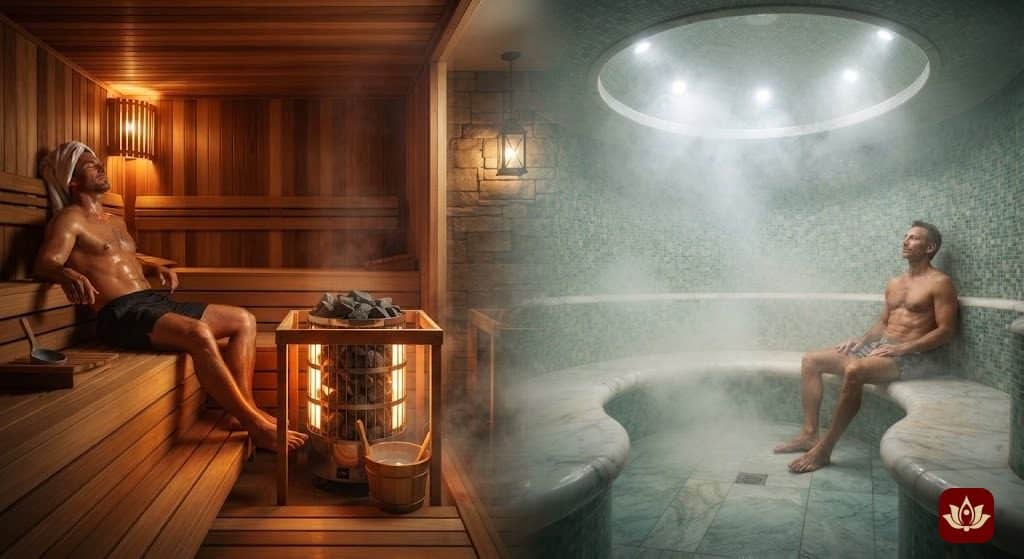
A dry sauna is traditionally housed within natural wood cabins constructed from fragrant timbers like cedar or pine. It operates at much higher temperatures—typically ranging between $70^{\circ}C$ and $100^{\circ}C$ ($158^{\circ}F$ to $212^{\circ}F$)—while maintaining a very low relative humidity of just $10\%$ to $20\%$. This arid, high heat rapidly elevates the heart rate and induces deep, profuse perspiration.
+————————+———————————–+———————————–+
| Feature | Dry Sauna | Steam Sauna |
+————————+———————————–+———————————–+
| Ambient Temperature | High ($70^{\circ}C – 100^{\circ}C$) | Mild ($40^{\circ}C – 50^{\circ}C$) |
| Relative Humidity | Low ($10\% – 20\%$) | Very High (approx. $100\%$) |
| Primary Construction | Natural Wood (Cedar or Pine) | Tile, Ceramic, or Waterproof Stone|
| Core Therapeutic Effect| Deep Detox & Muscle Recovery | Skin Cleansing & Respiratory Health|
+————————+———————————–+———————————–+
In contrast, a steam sauna (or Hammam) is an enclosed room lined with moisture-resistant tiles or stone. It features a lower ambient temperature—roughly $40^{\circ}C$ to $50^{\circ}C$ ($104^{\circ}F$ to $122^{\circ}F$)—paired with a relative humidity that reaches a staggering $100\%$. The thick, condensed vapor prevents sweat from evaporating off the skin’s surface, transferring heat in a completely different, enveloping manner. Knowing these structural details empowers you to select the ideal environment based on your respiratory comfort and heat tolerance.
Comprehensive Benefits of a Dry Sauna
Because dry saunas trigger heavy sweating and boost peripheral circulation, they offer an array of therapeutic and cosmetic advantages.
- Joint and Muscle Pain Relief: The deep heat generated by hot rocks penetrates deep into musculoskeletal tissues, releasing chronic tension and knots. This makes dry saunas a favorite post-workout ritual for athletes and individuals dealing with persistent muscle spasms.
- Immune Support and Gentle Caloric Burn: The temporary rise in core body temperature acts similarly to an artificial fever, stimulating white blood cell production and supporting immune function.
To experience these benefits in a pristine, tranquil setting, explore our professional Massage Services to complement your physical recovery routine.
The Astonishing Benefits and Properties of a Steam Sauna
If you have dry, sensitive skin or experience occasional respiratory congestion, a steam sauna serves as an extraordinary sanctuary.
- Deep Skin Cleansing: The $100\%$ humidity level softens the stratum corneum layer of the skin, effortlessly purging impurities, toxins, and trapped debris from dilated pores.
- Respiratory Wellness: Moist heat coats and hydrates the mucous membranes, helping to ease the symptoms of colds, sinusitis, and seasonal allergies.
- Cardiovascular Gentleness: Because the ambient air is cooler than a dry sauna, it places less strain on the cardiovascular system, allowing individuals with lower heat endurance to relax comfortably for longer stretches.
To learn more about access and pricing for these tailored wellness packages, our comprehensive Spa Treatments guide will point you in the right direction.
The Dos and Don’ts of Using a Sauna Before a Massage
One of the most frequent questions spa guests ask is: Is it safe to use a sauna before a massage?
The short answer is yes, provided you follow proper timing and safety protocols. Entering a thermal cabin prior to your bodywork helps relax tense muscles, dilates blood vessels, and primes your body to fully absorb therapeutic botanical oils and massage techniques.
Important Timing Rule: Never transition straight from a hot sauna onto a massage table. Allow a mandatory 15 to 20-minute rest window between leaving the sauna and starting your session. This pause allows your core body temperature to normalize, rehydrates your system, and lets your heart rate return to a resting rhythm.
For specialized insights into enhancing your holistic wellness routine, browse our curated collection of articles on the Niloufar Abi Blog.
Key Contraindications: When to Avoid the Sauna
Despite their extensive therapeutic perks, saunas carry certain medical contraindications that require careful self-assessment before entry.
- Who Should Avoid Saunas: Individuals suffering from severe cardiovascular disease, uncontrolled hypertension, epilepsy, or women who are pregnant should steer clear of intense thermal cabins—particularly high-heat dry saunas—unless explicitly cleared by a physician.
- Time Limits: Lingering inside a cabin past the recommended limit (more than $15$ to $20$ minutes per round) dramatically increases the risk of dizziness, severe blood pressure drops, and acute dehydration.
- Post-Sauna Care: Always rehydrate with plenty of water before and after your session, and finish with a lukewarm shower to safely close your skin pores.
Ready to find your inner calm? Visit our Book Now page to coordinate your next visit and plan your personalized wellness escape.
Conclusion
Recognizing the distinct differences between dry and steam saunas is the master key to unlocking their maximum healing and restorative potential. While a dry sauna excels at deep muscular recovery and intense sweating, a steam sauna uses rich humidity to nurture skin vitality and respiratory health. When combined mindfully with pre-massage rituals, these therapies yield an unmatched feeling of lightness and liberation. Niloufar Abi Spa’s expert therapists and world-class facilities are dedicated to crafting moments of profound peace and health for you.
Frequently Asked Questions
- What is the primary difference between a dry and a steam sauna? The fundamental difference lies in their temperature and humidity profiles. A dry sauna features high heat and low humidity for intense perspiration, whereas a steam sauna utilizes a milder temperature paired with $100\%$ humidity to focus on skin cleansing and respiratory support.
- Is it safe to use a sauna before a massage? Yes, using a sauna beforehand relaxes muscles and increases blood circulation; however, you must rest for $15$ to $20$ minutes afterward to let your body temperature and heart rate normalize before your massage begins.
- Who should avoid using a sauna? People with severe heart conditions, unstable blood pressure, pregnancy, or those prone to sudden dizziness should avoid saunas or consult a doctor beforehand.
- What is the ideal duration for a single sauna session? Averaging $10$ to $15$ minutes per session is safe and sufficient. Always step out to cool down, drink water, and rest before attempting another round.